

Fuel Cell UAV Market Set to Reach US$ 4.47 Billion by 2035 Amid Rising Demand for Zero-Emission Unmanned Aerial Systems
Fuel Cell UAV Market Report
The global Fuel Cell UAV Market is witnessing a transformative phase as governments, defense organizations, logistics providers, and commercial drone operators increasingly adopt hydrogen fuel cell technologies to overcome the endurance limitations of conventional battery-powered unmanned aerial vehicles. Fuel cell UAVs provide extended flight durations, higher operational efficiency, reduced emissions, and improved payload capabilities, making them an attractive solution for both military and commercial applications.
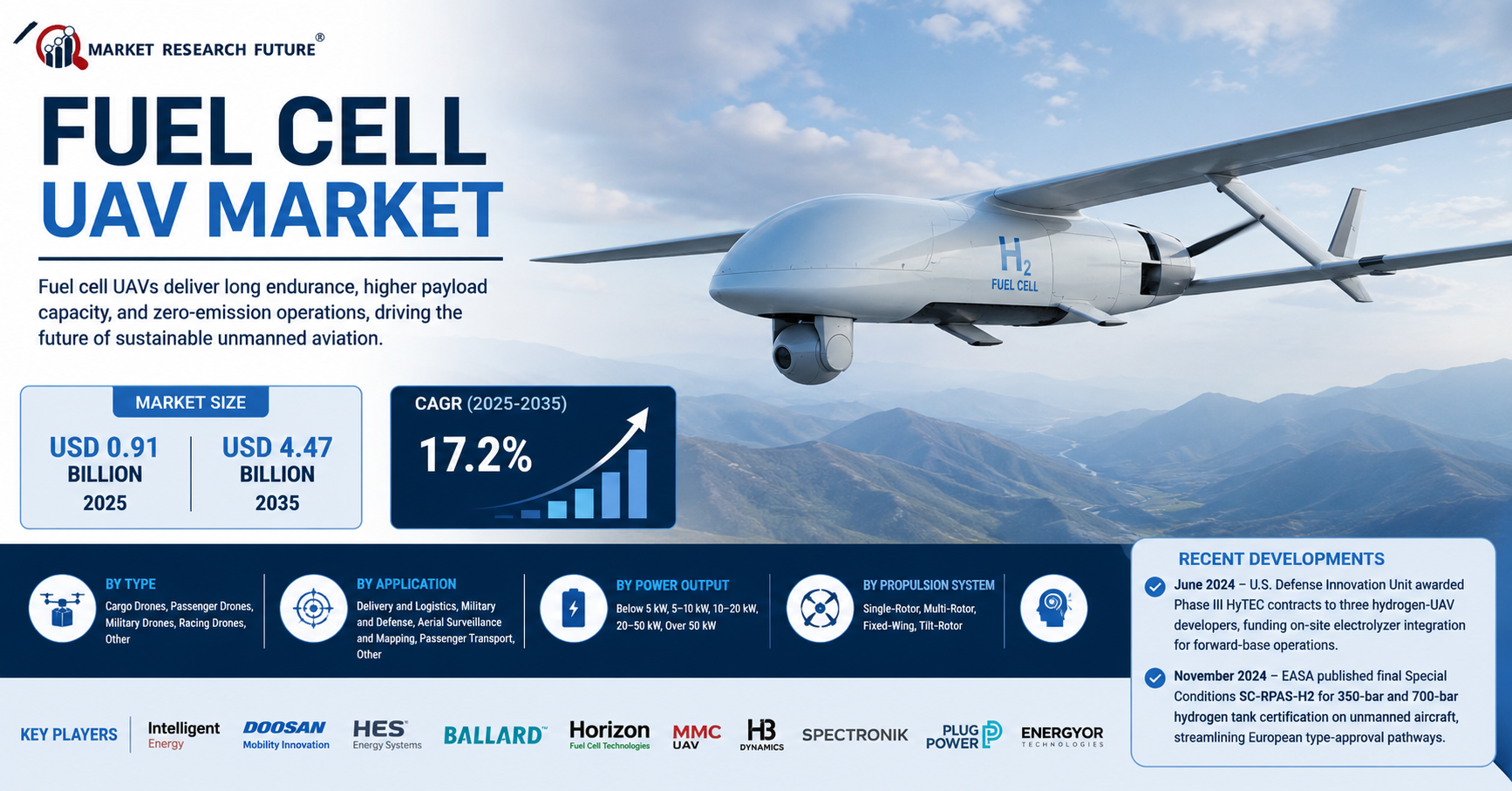
According to recent market analysis, the Fuel Cell UAV Market was valued at USD 0.91 Billion in 2025 and is projected to reach USD 4.47 Billion by 2035, expanding at a CAGR of 17.2% during the forecast period from 2025 to 2035. The market’s growth trajectory is being driven by increasing investments in hydrogen infrastructure, advancements in fuel cell technologies, growing demand for beyond-visual-line-of-sight (BVLOS) drone operations, and the rising need for sustainable aerial mobility solutions.
Market Overview:
Fuel cell UAVs utilize hydrogen fuel cells as a primary power source, generating electricity through an electrochemical reaction between hydrogen and oxygen. Unlike traditional battery-powered drones, fuel cell-powered UAVs can remain airborne for significantly longer durations while maintaining consistent performance throughout flight operations.
The increasing adoption of UAVs across industries such as defense, logistics, surveillance, infrastructure inspection, agriculture, and emergency response has intensified the demand for technologies capable of extending flight endurance. Fuel cells have emerged as a viable alternative because they offer superior energy density, rapid refueling capabilities, and reduced environmental impact.
As countries worldwide accelerate decarbonization initiatives and invest heavily in hydrogen ecosystems, fuel cell UAVs are expected to play a crucial role in the future of autonomous aviation and unmanned transportation.
Request Sample PDF of Report: https://www.marketresearchfuture.com/sample_request/27361
Latest Market Trends:
1. Growing Adoption of Hydrogen-Powered Drone Platforms
One of the most significant trends shaping the Fuel Cell UAV Market is the increasing adoption of hydrogen-powered drone platforms. Organizations are shifting their focus toward fuel cell systems that enable longer flight times and support heavier payloads than lithium-ion battery alternatives.
This trend is particularly evident in defense operations, infrastructure monitoring, maritime surveillance, and long-distance cargo transportation, where mission endurance is critical.
2. Expansion of Beyond Visual Line of Sight (BVLOS) Operations
Regulatory agencies worldwide are progressively enabling BVLOS drone operations. Such missions require UAVs capable of remaining airborne for extended periods without frequent recharging or battery replacement.
Fuel cell UAVs address this requirement effectively, encouraging drone manufacturers and service providers to integrate hydrogen fuel cell technologies into next-generation platforms.
3. Increased Integration of Artificial Intelligence and Autonomous Navigation
Advanced fuel cell UAVs are increasingly being equipped with artificial intelligence, machine learning algorithms, and autonomous navigation systems. These technologies improve route optimization, obstacle avoidance, mission planning, and operational efficiency.
The combination of long-endurance fuel cell power systems and intelligent autonomous technologies is creating new opportunities across defense, logistics, environmental monitoring, and public safety sectors.
4. Emergence of Sustainable Aviation Solutions
Environmental sustainability has become a major priority for aviation stakeholders. Fuel cell UAVs produce minimal emissions compared to fossil-fuel-powered alternatives, aligning with global climate objectives. Governments and organizations are therefore investing in hydrogen-powered aviation initiatives to support carbon-neutral transportation strategies.
5. Advancements in Lightweight Fuel Cell Systems
Manufacturers are developing lighter and more efficient fuel cell stacks, hydrogen storage systems, and power management technologies. These innovations are improving UAV performance while reducing overall system weight. Enhanced energy density and compact designs are enabling fuel cell UAVs to support increasingly complex commercial and defense missions.
Market Drivers:
1. Rising Demand for Long-Endurance UAV Operations
Traditional battery-powered drones often face operational constraints due to limited flight duration. Industries requiring extended aerial operations increasingly seek alternative power solutions capable of supporting longer missions.
Fuel cell systems significantly extend flight times, making them highly suitable for surveillance, mapping, infrastructure inspection, border security, and disaster response applications.
2. Growing Defense and Military Investments
Defense agencies worldwide are investing heavily in advanced UAV technologies to strengthen intelligence, surveillance, reconnaissance, and tactical capabilities.
Fuel cell-powered UAVs provide critical advantages such as extended operational range, reduced logistical burden, lower acoustic signatures, and enhanced mission flexibility. These benefits are driving increased military adoption across multiple regions.
3. Expansion of Commercial Drone Applications
Commercial drone deployment continues to increase across sectors including agriculture, logistics, mining, energy, telecommunications, and construction. As businesses seek more efficient and cost-effective drone operations, fuel cell technologies offer a compelling solution by minimizing downtime and improving mission productivity.
4. Supportive Hydrogen Economy Initiatives
Governments worldwide are introducing policies, funding programs, and infrastructure investments aimed at accelerating hydrogen adoption. These initiatives are fostering technological innovation, encouraging commercialization efforts, and supporting the broader adoption of hydrogen-powered UAV systems.
5. Growing Need for Environmental Sustainability
Organizations are under increasing pressure to reduce carbon emissions and adopt environmentally responsible technologies. Fuel cell UAVs support sustainability goals by offering cleaner energy solutions while maintaining high operational performance, contributing to market expansion.
Market Opportunities:
1. Development of Hydrogen Infrastructure Networks
The gradual expansion of hydrogen production, transportation, and refueling infrastructure creates substantial opportunities for fuel cell UAV manufacturers. Improved accessibility to hydrogen fuel can significantly enhance operational feasibility and accelerate commercial adoption across diverse industries.
2. Expansion of Drone Delivery Services
E-commerce growth and increasing demand for rapid delivery services are creating favorable conditions for fuel cell-powered cargo drones. The extended range and endurance offered by fuel cells can support long-distance delivery missions, enabling logistics companies to optimize operations and expand service coverage.
3. Growth in Emergency Response Applications
Fuel cell UAVs are increasingly being utilized in disaster management, search-and-rescue operations, wildfire monitoring, and humanitarian missions. Their ability to remain airborne for prolonged periods provides emergency responders with valuable real-time intelligence during critical situations.
4. Increasing Demand for Remote Infrastructure Monitoring
Energy pipelines, power transmission networks, railways, telecommunications infrastructure, and offshore facilities require continuous inspection and monitoring. Fuel cell UAVs offer efficient long-range capabilities that support these activities while reducing operational costs and improving safety.
5. Emerging Urban Air Mobility Ecosystem
As urban air mobility initiatives gain momentum, fuel cell technologies are expected to play an increasingly important role in supporting next-generation autonomous aerial transportation systems. The experience gained through fuel cell UAV deployment will likely contribute to broader hydrogen aviation advancements.
Segment Analysis:
1. By Type
Cargo Drones - Cargo drones represent a rapidly expanding segment within the Fuel Cell UAV Market. These platforms benefit significantly from fuel cell technology due to their need for extended range and increased payload capacity. Logistics providers are exploring hydrogen-powered cargo drones to improve delivery efficiency and support remote-area transportation.
Passenger Drones - Passenger drones are emerging as a future mobility solution. Although still in developmental stages, fuel cell technology offers promising advantages including longer operational endurance and cleaner propulsion, making it attractive for future urban air mobility applications.
Military Drones - Military drones account for a significant share of market demand. Armed forces increasingly utilize fuel cell-powered UAVs for surveillance, reconnaissance, intelligence gathering, and tactical missions where extended flight duration is essential.
Racing Drones - Racing drones are exploring advanced power technologies to achieve improved performance and extended operational capability. Fuel cell innovations may enhance competitive drone operations in specialized applications.
Other - The “Other” category includes research, environmental monitoring, agricultural, scientific, and industrial drones utilizing fuel cell technologies for specialized operational requirements.
2. By Application
Delivery and Logistics - The delivery and logistics segment is witnessing substantial growth due to rising e-commerce activities and increasing demand for efficient last-mile delivery solutions. Fuel cell UAVs enable longer flight routes and greater operational efficiency.
Military and Defense - Military and defense applications continue to drive significant market growth. Fuel cell UAVs support persistent surveillance, border security, reconnaissance, and tactical operations requiring extended mission endurance.
Aerial Surveillance and Mapping - Organizations involved in surveying, mapping, infrastructure inspection, and environmental monitoring increasingly adopt fuel cell UAVs to improve operational coverage and reduce mission interruptions.
Passenger Transport - Passenger transport applications represent a long-term opportunity. Fuel cell technologies provide an environmentally sustainable pathway for future aerial mobility systems.
Other - Additional applications include agriculture, disaster management, scientific research, maritime monitoring, and industrial inspections.
3. By Power Output
Below 5 kW - These systems are commonly utilized in smaller UAV platforms requiring lightweight power solutions for commercial and surveillance applications.
5-10 kW - The 5-10 kW segment serves medium-sized UAVs operating across logistics, mapping, and industrial inspection missions.
10-20 kW - This category supports larger drones requiring increased endurance and payload capacity, particularly within defense and commercial sectors.
20-50 kW - Fuel cell systems within this range are suitable for advanced UAV platforms conducting demanding long-duration missions.
Over 50 kW -The over 50 kW segment represents future high-performance UAV applications involving heavy payload transport, advanced military operations, and emerging aerial mobility platforms.
4. By Propulsion System
Single-Rotor - Single-rotor UAVs benefit from fuel cell technology by achieving extended flight endurance while maintaining operational stability.
Multi-Rotor - Multi-rotor platforms are widely used across commercial applications. Fuel cell integration improves flight duration and expands mission capabilities.
Fixed-Wing - Fixed-wing UAVs represent a major application area for fuel cells due to their suitability for long-range missions and high endurance requirements.
Tilt-Rotor - Tilt-rotor platforms combine vertical takeoff capabilities with efficient forward flight, making them attractive candidates for fuel cell propulsion systems.
5. By Autonomy Level
Semi-Autonomous - Semi-autonomous UAVs continue to dominate many operational environments where human oversight remains essential.
High-Autonomous - High-autonomous platforms leverage advanced navigation technologies and AI-driven decision-making to improve mission efficiency and operational flexibility.
Full-Autonomous - Fully autonomous UAVs represent the future of unmanned aviation. Fuel cell technology provides the endurance required for long-duration autonomous missions across various sectors.
Regional Analysis:
North America - North America remains one of the most influential markets for fuel cell UAV technologies. The region benefits from strong defense spending, advanced aerospace capabilities, robust hydrogen research initiatives, and increasing investments in drone innovation. The United States plays a particularly important role due to extensive military UAV deployment and government support for hydrogen-powered aviation technologies.
Europe - Europe is emerging as a major growth center for fuel cell UAV development. The region’s commitment to sustainability, clean energy transition, and hydrogen infrastructure expansion supports increasing market adoption. European regulatory frameworks are also becoming more supportive of hydrogen-powered aviation, creating favorable conditions for commercialization.
Asia-Pacific - Asia-Pacific is expected to experience substantial market growth throughout the forecast period. Countries including China, Japan, South Korea, and India are investing heavily in hydrogen technologies, advanced manufacturing capabilities, and UAV innovation. Growing industrialization, expanding logistics networks, and rising defense modernization programs further support regional demand.
South America - South America is gradually adopting fuel cell UAV solutions for environmental monitoring, infrastructure inspection, agriculture, and resource management applications. Increasing awareness of sustainable technologies is expected to encourage future market expansion across the region.
Middle East & Africa - The Middle East & Africa region is witnessing growing interest in hydrogen technologies and unmanned systems. Investments in smart infrastructure, security operations, and renewable energy initiatives are creating opportunities for fuel cell UAV deployment. Several countries are also exploring hydrogen economy strategies that may support future market development.
Competitive Landscape:
The Fuel Cell UAV Market features a combination of fuel cell technology developers, UAV manufacturers, hydrogen infrastructure providers, and aerospace innovators focused on enhancing endurance, reliability, and operational efficiency.
Key market participants continue to invest in research and development activities, strategic partnerships, product innovation, and commercialization initiatives to strengthen their competitive positions.
Intelligent Energy - Intelligent Energy is recognized for developing advanced fuel cell technologies designed to enhance UAV flight duration and operational performance. The company remains focused on lightweight and efficient hydrogen-powered solutions.
Doosan Mobility Innovation - Doosan Mobility Innovation specializes in hydrogen fuel cell drone systems and has established a strong presence within the commercial UAV sector through innovative long-endurance platforms.
HES Energy Systems - HES Energy Systems develops integrated hydrogen propulsion technologies for aviation applications, supporting the growing adoption of sustainable UAV solutions.
Ballard Power Systems - Ballard Power Systems is a global leader in proton exchange membrane fuel cell technology and continues to expand its presence across aerospace and unmanned aviation markets.
Horizon Fuel Cell Technologies - Horizon Fuel Cell Technologies provides hydrogen fuel cell systems and energy solutions that support commercial and industrial UAV operations worldwide.
MMC UAV - MMC UAV focuses on developing advanced unmanned aerial systems and fuel cell-powered drone platforms for commercial and defense applications.
H3 Dynamics - H3 Dynamics combines hydrogen technologies with digital aviation solutions to support next-generation autonomous UAV operations.
Spectronik - Spectronik contributes to the advancement of fuel cell UAV technologies through innovative hydrogen-powered aviation solutions and system integration capabilities.
Plug Power - Plug Power is actively involved in hydrogen ecosystem development and fuel cell innovation, supporting broader adoption across transportation and aerospace sectors.
EnergyOr Technologies - EnergyOr Technologies develops lightweight fuel cell systems specifically engineered for UAV applications, helping operators achieve longer flight durations and improved mission performance.
Recent News & Developments:
June 2024 – U.S. Defense Innovation Unit
The U.S. Defense Innovation Unit awarded Phase III HyTEC contracts to three hydrogen-powered UAV developers. The initiative focuses on supporting the integration of on-site electrolyzer technologies for forward operating bases, enabling more efficient hydrogen production and fueling capabilities for military drone operations.
November 2024 – EASA
The European Union Aviation Safety Agency (EASA) introduced final Special Conditions SC-RPAS-H2 covering certification requirements for 350-bar and 700-bar hydrogen storage tanks used in unmanned aircraft. The new framework is expected to simplify certification processes and accelerate the deployment of hydrogen-powered UAV systems across European markets.
Future Outlook:
The Fuel Cell UAV Market is poised for robust growth through 2035 as technological advancements continue to improve fuel cell efficiency, hydrogen storage capabilities, and autonomous flight performance. Rising demand for sustainable aviation solutions, expanding defense modernization initiatives, and increasing adoption of long-endurance commercial drones will remain primary growth catalysts.
As hydrogen infrastructure expands and regulatory frameworks mature, fuel cell UAVs are expected to become increasingly mainstream across logistics, surveillance, mapping, emergency response, and military applications. With a projected market value of USD 4.47 Billion by 2035 and a strong CAGR of 17.2%, the industry is positioned to play a pivotal role in the future of unmanned aviation and hydrogen-powered aerospace innovation.
Browse More Reports:
Military UAV Sensor Market
https://www.marketresearchfuture.com/reports/military-uav-sensor-market-1-67347
Fixed Wing VTOL UAV Market
https://www.marketresearchfuture.com/reports/fixed-wing-vtol-uav-market-27227
Small UAV Market
https://www.marketresearchfuture.com/reports/small-uav-market-1136
Critical Incident Monitoring UAV Market
https://www.marketresearchfuture.com/reports/critical-incident-monitoring-uav-market-23939
Sagar Kadam
Market Research Future
+1 628-258-0071
email us here
Visit us on social media:
LinkedIn
Facebook
X
Legal Disclaimer:
EIN Presswire provides this news content "as is" without warranty of any kind. We do not accept any responsibility or liability for the accuracy, content, images, videos, licenses, completeness, legality, or reliability of the information contained in this article. If you have any complaints or copyright issues related to this article, kindly contact the author above.
