

Software Defined Radio Market to Reach US$ 41.28 Billion by 2035, Growing at 7.4% of CAGR with Telecom Expansion
Software Defined Radio Market
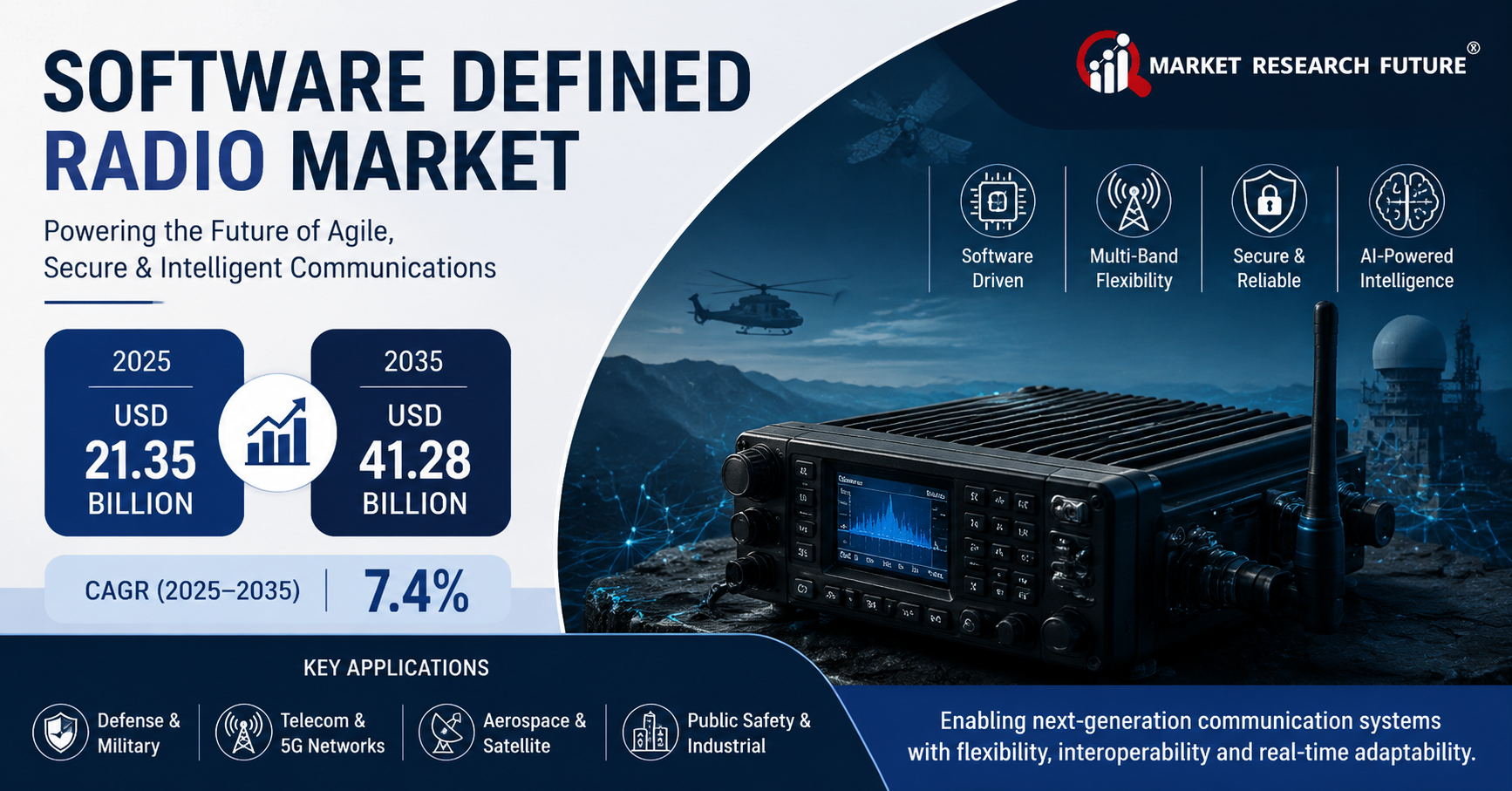
The global Software Defined Radio (SDR) Market is witnessing a strong growth trajectory as industries increasingly transition toward flexible, programmable, and multi-band communication architectures. Valued at USD 21.35 Billion in 2025, the market is projected to reach USD 41.28 Billion by 2035, expanding at a CAGR of 7.4% during the forecast period (2025–2035). The rising demand for interoperable communication systems across defense modernization programs, 5G/6G infrastructure, and mission-critical public safety networks is reshaping the SDR ecosystem globally.
Software defined radio technology enables the reconfiguration of communication systems through software upgrades rather than hardware replacement, significantly improving adaptability, lifecycle cost efficiency, and spectrum utilization. This capability is becoming a cornerstone for next-generation communication systems across military, aerospace, telecom, and industrial sectors.
Market Overview and Growth Outlook:
The SDR market is expanding rapidly due to the convergence of AI-enabled signal processing, Open RAN architectures, and cognitive radio systems. Increasing complexity in wireless communication environments is driving demand for programmable RF systems that can dynamically adapt to multiple waveforms and frequency bands.
Key market indicators highlight strong global expansion -
2025 Market Size: USD 21.35 Billion
2035 Forecast Value: USD 41.28 Billion
CAGR (2025–2035): 7.4%
Strong adoption in defense, telecom, aerospace, and public safety applications
The growth is further reinforced by modernization initiatives in defense communication systems and increasing deployment of private 5G networks in enterprise ecosystems.
Request Sample PDF of Report: https://www.marketresearchfuture.com/reports/software-defined-radio-market-5893
Latest Trends in the Software Defined Radio Market:
The SDR industry is undergoing structural transformation driven by advanced technologies and evolving communication requirements.
1. AI-Driven Spectrum Intelligence
Artificial intelligence is increasingly integrated into SDR platforms to optimize spectrum allocation, reduce interference, and improve real-time signal classification. AI-enabled SDR systems are becoming essential for electronic warfare and adaptive communication networks.
2. Expansion of Open RAN Ecosystems
Telecommunication operators are rapidly adopting Open Radio Access Network (Open RAN) frameworks, which heavily rely on SDR technology for virtualization and software-based radio control.
3. Military Digitalization and Network-Centric Warfare
Defense forces worldwide are upgrading legacy communication systems to SDR-based platforms to support multi-domain operations, secure communications, and interoperability across allied forces.
4. Growth of LEO Satellite Communication Systems
Low Earth Orbit (LEO) satellite networks are increasingly deploying SDR payloads for flexible frequency reconfiguration and real-time mission updates.
5. Transition Toward Cognitive and Adaptive Radios
Cognitive radio systems capable of sensing and adapting to spectrum environments are gaining momentum in both commercial and defense applications.
Market Key Drivers:
1. Rising Defense Modernization Programs
Global defense agencies are prioritizing advanced communication systems capable of secure, jam-resistant, and multi-waveform operations, significantly boosting SDR adoption.
2. Expansion of 5G and Beyond Networks
The deployment of 5G and preparation for 6G networks is increasing demand for programmable radio architectures capable of handling ultra-wideband frequencies and dynamic network slicing.
3. Demand for Interoperable Communication Systems
Industries such as aviation, maritime, and emergency services require seamless interoperability, which SDR systems effectively provide.
4. Increasing Spectrum Scarcity
Efficient spectrum utilization is driving the adoption of SDR technologies that dynamically manage frequency allocation.
Market Opportunities:
The Software Defined Radio (SDR) market is opening new growth avenues across defense, telecommunications, aerospace, and industrial communication ecosystems as global demand shifts toward fully programmable and adaptive communication infrastructures.
One of the most significant opportunities lies in the rapid expansion of private 5G and industrial 4G/5G networks, where enterprises require flexible radio systems capable of supporting multiple protocols and dynamically changing network conditions. SDR platforms are increasingly being deployed in manufacturing plants, energy grids, and logistics hubs to enable low-latency, high-reliability communication environments.
Another major opportunity is emerging from the integration of SDR with artificial intelligence and machine learning systems. AI-enabled SDRs are capable of real-time spectrum optimization, automatic waveform selection, and adaptive interference mitigation, which is particularly valuable in defense electronic warfare and autonomous communication systems.
The rising adoption of satellite-based broadband connectivity, especially Low Earth Orbit (LEO) constellations, is also creating strong demand for SDR technology. These systems require flexible radio payloads that can be updated remotely through software, enabling rapid adjustments to evolving orbital and bandwidth requirements.
Additionally, the growing focus on next-generation electronic warfare (EW) and signals intelligence (SIGINT) solutions presents substantial opportunities for SDR vendors. Modern defense systems increasingly rely on reconfigurable radios that can detect, analyze, and respond to hostile signals in real time.
Finally, the convergence of SDR with edge computing, Internet of Things (IoT), and cloud-native communication architectures is expected to unlock new commercial applications across smart cities, autonomous transportation, and critical infrastructure monitoring.
Regional Analysis:
North America - North America continues to dominate the Software Defined Radio market due to its advanced defense infrastructure, high defense spending, and early adoption of cutting-edge communication technologies. The United States, in particular, leads global SDR innovation through extensive deployment in military modernization programs, aerospace communication systems, and next-generation tactical radio networks.
Europe - Europe represents a strong and steadily growing market driven by NATO interoperability requirements and increasing investments in secure defense communication systems. Countries across the region are actively modernizing their military communication infrastructure to ensure seamless coordination in multinational defense operations.
Asia-Pacific - Asia-Pacific is emerging as the fastest-growing regional market, supported by rising defense budgets, rapid 5G deployment, and significant investments in indigenous communication technologies. Countries such as China, India, Japan, and South Korea are accelerating SDR adoption across both defense and commercial telecom applications.
Middle East & Africa - The Middle East & Africa region is experiencing gradual but consistent growth, fueled by smart defense initiatives, modernization of military communication systems, and large-scale investments in smart city infrastructure and secure public safety networks.
South America - South America is witnessing moderate adoption of SDR technologies, primarily in public safety communication, border surveillance systems, and industrial applications such as mining and energy sector communications.
Segment Analysis:
The Software Defined Radio market is segmented based on component, end-user, platform, and frequency band, each contributing differently to overall market growth.
1. By Component
Hardware Segment: Continues to hold a significant share due to demand for RF transceivers, antennas, and signal processing units that form the physical foundation of SDR systems.
Software Segment: Expected to grow at the fastest rate, driven by increasing demand for waveform virtualization, AI-based signal intelligence, and cloud-based radio management platforms.
2. By End-User
Government & Defense: Remains the dominant segment due to high reliance on secure, encrypted, and interoperable communication systems for military operations.
Commercial Sector: Rapidly expanding segment driven by telecom operators, enterprise private networks, and industrial automation use cases.
3. By Platform
Land-Based Systems: Account for the largest share, including tactical radios, vehicular communication systems, and base stations.
Air & Space Platforms: Represent the fastest-growing segment, supported by UAV communication systems, satellite payloads, and airborne command networks.
4. By Frequency Band
The SDR market spans multiple frequency bands including HF, VHF, UHF, SHF, and mmWave, enabling applications ranging from tactical battlefield communication to high-capacity satellite data transmission.
Recent Developments in the Software Defined Radio Market:
Recent developments in the Software Defined Radio (SDR) ecosystem reflect a steady shift toward software-centric defense communication systems, Open RAN integration, and advanced spectrum intelligence capabilities. While the market is highly innovation-driven, most advancements are centered around defense modernization programs, telecom virtualization, and satellite communication upgrades.
January 2025: Defense organizations across multiple regions intensified efforts to modernize tactical communication infrastructure by increasing deployment of software-defined radio systems to enhance secure and interoperable battlefield communications.
March 2025: Telecommunications operators expanded trials of Open RAN-based architectures, where SDR technology played a critical role in enabling software-controlled radio access and improving network flexibility.
June 2025: Growth in satellite communication initiatives supported the integration of SDR-based payload systems in next-generation satellite networks, enabling dynamic frequency management and improved service adaptability.
September 2025: Increased focus on electronic warfare modernization programs led to broader adoption of SDR platforms capable of supporting multi-waveform operations and real-time signal adaptation in complex mission environments.
November 2025: Industrial and enterprise communication networks began accelerating adoption of SDR-enabled private network solutions, particularly in sectors requiring highly reliable and configurable wireless communication systems.
These developments collectively highlight the ongoing transformation of communication systems from hardware-centric architectures to fully software-defined, adaptive, and AI-ready radio ecosystems.
Key Players in the Software Defined Radio Market:
The Software Defined Radio market is characterized by the presence of established defense contractors, aerospace communication providers, and advanced telecom technology companies. These organizations are actively investing in next-generation radio architectures, secure communication systems, and open-standard interoperability frameworks. Major Market Participants -
L3Harris Technologies
RTX Corporation
Thales Group
General Dynamics Corporation
Northrop Grumman Corporation
BAE Systems
Elbit Systems
Leonardo S.p.A.
Collins Aerospace
Rohde & Schwarz
Raytheon Technologies
Competitive Landscape Overview -
These key players are focusing on strengthening their market position through continuous innovation in multi-band tactical radios, AI-powered signal processing systems, and software-upgradable communication platforms. A significant emphasis is being placed on adopting open architecture frameworks such as SOSA (Sensor Open Systems Architecture) and CMOSS (C4ISR/EW Modular Open Suite of Standards) to enhance interoperability across defense and aerospace systems.
Strategic collaborations with government defense agencies, long-term military procurement contracts, and sustained R&D investments are shaping competitive dynamics in the SDR market. Additionally, companies are increasingly prioritizing integration of SDR systems with cloud computing, edge intelligence, and cognitive radio technologies to support next-generation communication requirements across both defense and commercial applications.
Industry Outlook:
The Software Defined Radio market is transitioning toward a highly software-centric and AI-integrated communication ecosystem. The convergence of defense digitalization, telecom virtualization, and satellite communication expansion is fundamentally reshaping the industry landscape.
Over the forecast period, SDR technology is expected to become a core enabler of next-generation communication infrastructures, supporting real-time adaptability, secure data exchange, and seamless interoperability across diverse platforms. The integration of cloud computing, edge processing, and cognitive radio capabilities will further enhance system intelligence and operational efficiency.
Browse More Reports:
Military Radio System Market
https://www.marketresearchfuture.com/reports/military-radio-system-market-4262
Land Mobile Radio Market
https://www.marketresearchfuture.com/reports/land-mobile-radio-market-5985
Defense Tactical Radio Market
https://www.marketresearchfuture.com/reports/defense-tactical-radio-market-31488
Radio Direction Finder Market
https://www.marketresearchfuture.com/reports/radio-direction-finder-market-23701
Sagar Kadam
Market Research Future
+1 628-258-0071
sales@marketresearchfuture.com
Visit us on social media:
LinkedIn
Facebook
X
Legal Disclaimer:
EIN Presswire provides this news content "as is" without warranty of any kind. We do not accept any responsibility or liability for the accuracy, content, images, videos, licenses, completeness, legality, or reliability of the information contained in this article. If you have any complaints or copyright issues related to this article, kindly contact the author above.
